
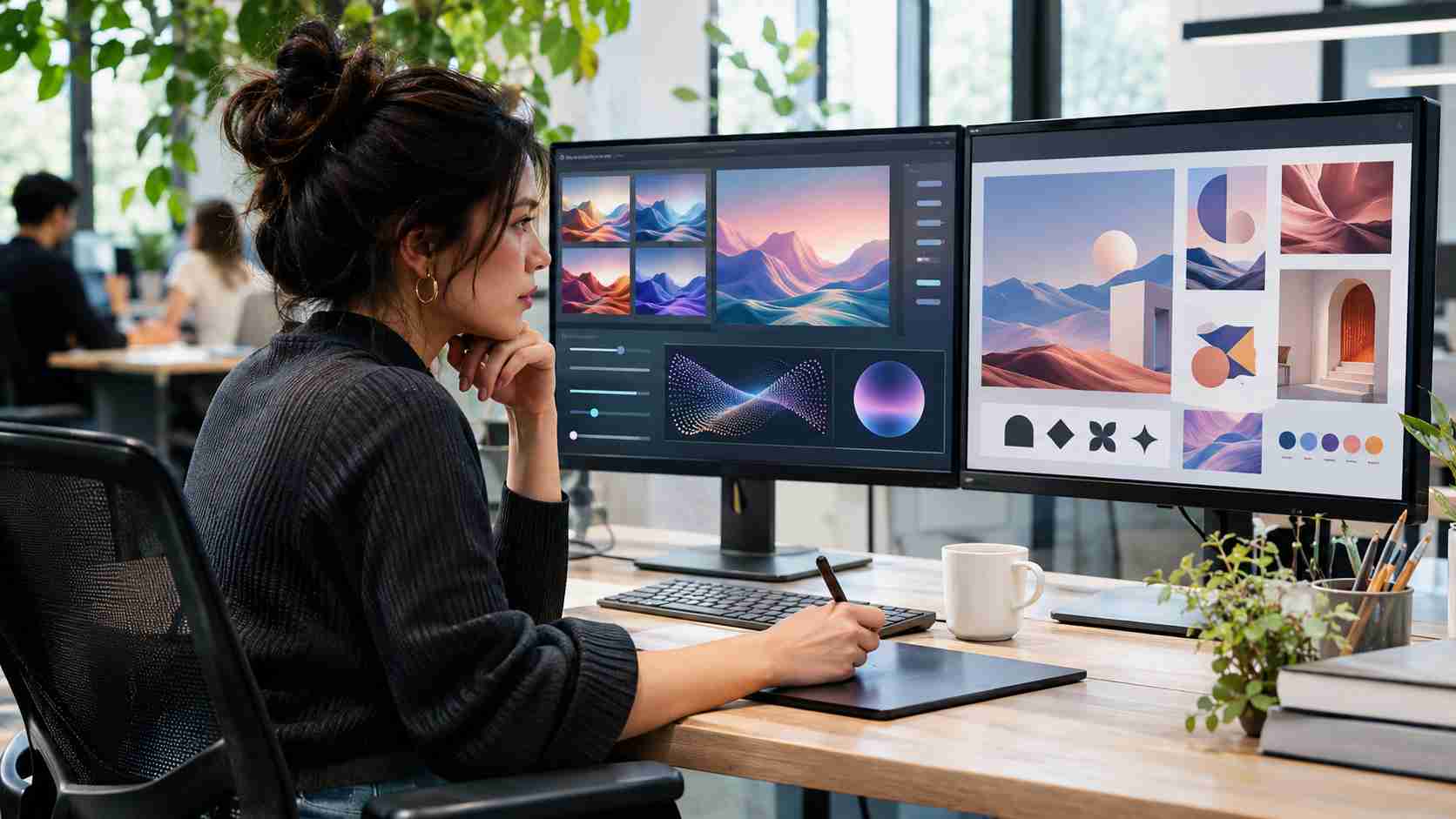
Artificial intelligence is changing how digital graphics are created, edited, and distributed. Generative image tools, automated layouts, and advanced editing software now help businesses produce illustrations, advertisements, infographics, and multimedia content. These technologies make visual production faster and more accessible. However, producing attractive images does not automatically guarantee effective communication.
Businesses, publishers, and content creators must decide whether automated tools can meet their creative and technical requirements. Some organizations combine AI applications with professional services through a graphic design outsource arrangement. This approach provides access to specialized skills while allowing internal teams to manage other responsibilities. The central question is whether AI-generated graphics can consistently match the accuracy, originality, and communication quality of human-created designs.
AI-powered design applications can transform written instructions into images, suggest layouts, remove backgrounds, and generate visual variations. These capabilities are useful for organizations managing frequent content updates.
A 2026 survey published by Adobe, involving more than 16,000 creators, found that 75% considered creative AI integrated or essential to their workflows. The findings reflect growing adoption, although they do not establish that AI consistently produces better designs.
Automated tools are particularly useful during early development. Designers can test several concepts before selecting a direction.
Common applications include:
These functions can reduce preparation time, especially when projects require numerous variations.
Research published by Adobe in June 2026 also found that brainstorming remains a major area where creative professionals integrate AI into their work.
Despite these advantages, AI-generated visuals can contain inaccurate details, inconsistent typography, and unsuitable compositions.
The National Institute of Standards and Technology identifies inaccurate or fabricated outputs as a significant generative AI risk. Such problems become particularly concerning when graphics communicate technical or factual information.
Copyright also requires attention. The U.S. Copyright Office explained in its 2025 report that purely AI-generated material generally lacks copyright protection under American law without sufficient human authorship.
Accessibility presents another challenge. The World Wide Web Consortium recommends suitable text alternatives, readable contrast, and accessible presentation of visual information. Automated graphics still require testing against these standards.
Professional graphic design involves more than arranging attractive elements. Designers consider audience expectations, communication objectives, brand identity, and the context where visuals appear.
They apply typography, color theory, composition, and visual hierarchy to direct attention toward important information.
The Nielsen Norman Group emphasizes that effective visual design depends on consistent layouts, clear hierarchy, strategic color choices, and careful typography. These principles support usability and understanding.
Human designers can interpret unclear instructions and recognize when an attractive graphic communicates the wrong message.
For example, a healthcare infographic requires accurate information, understandable symbols, and appropriate visual emphasis. An advertising illustration may prioritize emotional appeal instead.
Professional expertise is particularly valuable for:
External creative teams can provide these capabilities without requiring organizations to employ specialists for every design discipline.
However, professional design also has limitations. Complex projects require research, feedback, revisions, and coordination. These activities can increase production costs and extend delivery schedules.
Neither approach performs equally well across every design requirement.
AI tools generally offer advantages when creating preliminary concepts or numerous variations. Users can generate alternatives quickly, although complex corrections may require additional attempts.
Human designers usually provide greater control over detailed composition, typography, and communication priorities.
Automated tools can follow style references, but maintaining identical visual details across many outputs remains challenging.
Professional designers can establish reusable templates, design guidelines, and structured asset libraries.
This distinction matters for organizations managing long-term campaigns or multiple communication channels.
AI-generated graphics may need extensive corrections when text, proportions, or technical details are inaccurate.
Human-created files can offer more predictable revision workflows when properly organized and delivered in editable formats.
Maintaining reliable file access for creative workflows also helps teams retrieve design assets, coordinate revisions, and maintain consistency across projects.
However, maintenance quality ultimately depends on documentation, file structure, and consistent production standards, regardless of the tools used.
A hybrid workflow offers a practical alternative to choosing one approach exclusively.
AI can assist with idea generation and repetitive preparation, while professional designers manage creative direction and final quality.
A typical process might involve five stages:
This workflow combines automation with professional judgment.
Research from Adobe suggests that creative work is increasingly shifting toward selection, direction, and responsibility for final outputs rather than generating initial variations alone.
The appropriate choice depends on the purpose and complexity of the visual material.
AI-generated graphics are useful for experimentation, background imagery, and routine content production. Human designers remain especially valuable when projects demand original branding, precise communication, accessibility, or complex visual storytelling.
Organizations should evaluate total production effort rather than focusing exclusively on initial speed. Revision costs, consistency, and long-term asset management also influence results.
Looking ahead, increasingly capable automation will likely change creative workflows further. Yet effective visual communication will continue to depend on understanding audiences, presenting accurate information, and making thoughtful design decisions.
The strongest approach may therefore be a balanced one, where technology supports production efficiency and human expertise protects clarity, quality, and creative intent.